How to find the perfect meme coin entry and stop buying green candles out of FOMO
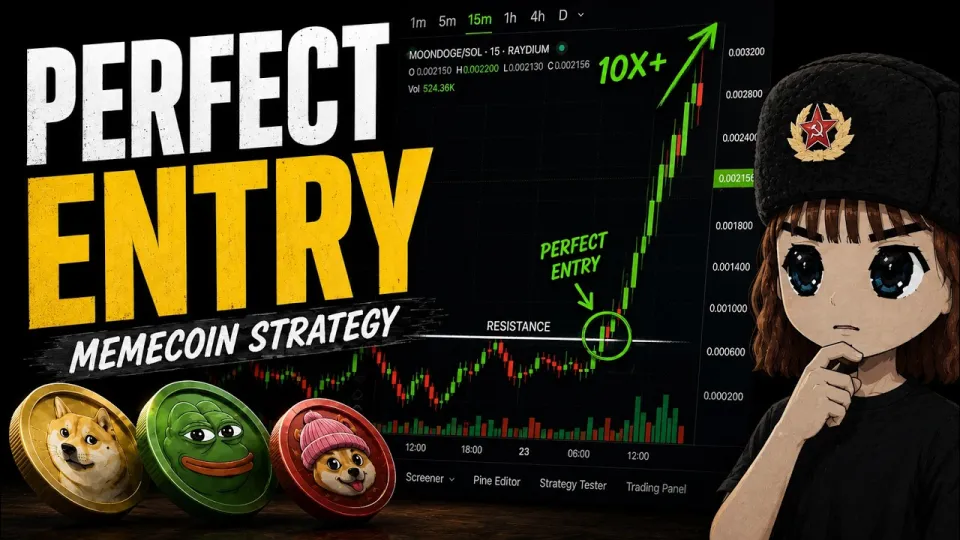
Video: How I Find the PERFECT Entry on Memecoins 📈 (Full Strategy)
You can order the same kind of articles for your own video to boost it on YouTube and Google. Just message the Telegram bot @sat_sit_bot. It writes articles around your video, embeds the video and publishes them on popular niche websites (no ads). Free trial — 50 articles.
· based on the channel starwifpump
Key takeaways
- Most meme coin losses come from bad timing, not bad coin selection — entry price decides the risk-to-reward ratio.
- A quality setup needs momentum confirmation without chasing an extended candle, plus a pullback to a support level.
- Invalidation signals (failed reclaim, fading volume, exhaustion wicks) matter as much as entry triggers.
- Risk, exit and profit-taking levels are planned before the trade, not after price moves.
- The full breakdown comes from the starwifpump video; early-access tools are distributed via the Plasma Telegram.
A meme coin entry is the price level where you buy after momentum is confirmed and price has pulled back to a defined support zone, with invalidation and exit levels set in advance. Most meme coin traders lose money not because they picked a bad coin, but because they bought an extended candle at the top of a pump. The fix is a repeatable process: confirm momentum, wait for the pullback, size the risk, and know where you are wrong before you click buy. The author of the strategy, starwifpump, points traders to the Plasma Telegram for early access, updates and setup help as the starting point for the toolkit used around this workflow.
Why the entry, not the coin, decides the outcome
Two traders can buy the same meme coin on the same day and get opposite results purely because of where they entered. A token that runs 300% from launch still produces losing buyers if they chase the last leg of the move, and a mediocre token can be a good trade if the entry sits close to a defended support level with a tight invalidation point.
The arithmetic is simple: the distance between your entry and your stop defines your position size for a fixed risk. Enter 40% higher on the same chart and either your stop gets wider (more capital at risk) or your size shrinks (less upside). That is why the whole process below is built around timing rather than narrative hunting — narrative tells you what to watch, the chart tells you when to act.
The four conditions of a high-quality meme coin setup
A valid entry in this framework needs four things to line up at once, and any missing condition downgrades the trade to a pass.
- Confirmed momentum. Price has already shown it can move: a strong impulse leg with expanding volume, not a flat chart hoping for a catalyst.
- A pullback, not a chase. After the impulse, price retraces into a zone — a prior consolidation, a breakout level, or a moving average that has been respected.
- Support that has been tested. The level held at least once before, ideally with a wick rejection or a higher low forming on the retest.
- A clear invalidation point. A specific price below which the setup is dead, close enough that the stop is affordable.
If the chart offers an impulse but no pullback, there is no trade — you wait. If it offers a pullback but momentum has already died, there is also no trade.
Reading momentum without chasing the pump
Momentum on a meme coin chart shows up as the relationship between candle body size, volume and the speed of the move. A healthy impulse has expanding volume into the move and a shallow, orderly retrace; an unhealthy one has a vertical candle on fading volume, long upper wicks, and a retrace that gives back most of the gain in a few bars.
The practical rule is to let the first impulse happen without you. Buying the vertical green candle means your stop has to sit far below, which destroys the risk-to-reward ratio. Instead, mark the level the impulse broke out from — that is your candidate entry zone — and wait for price to come back to it. If it never comes back, you missed a trade, not money. On Solana meme coins in particular, where a launch can double in minutes, this patience is the difference between a 2R trade and a −60% bag.
Using pullbacks and support levels to improve entries
A pullback entry works because it puts your stop just under a level the market has already defended. Map the chart in three steps before any buy:
- Mark the origin of the impulse. The consolidation or breakout level the move started from is the first support candidate.
- Mark the higher low. If price retests and prints a higher low above the origin, that low becomes the tighter, better entry reference.
- Define the zone, not a single price. Meme coins are thin and wick hard; entering in a band of a few percent is more realistic than a limit order at one tick.
Once price is inside the zone, look for a reaction: a wick that gets bought back, a reclaim of a short-term level, or a volume uptick on the retest. That reaction is the confirmation that turns a level into an entry. Without it, the zone is just a line on a chart.
Red flags that tell you not to enter
Knowing when to stand aside is half of the strategy, because the setups you skip are the ones that protect the account. The signals that cancel a long idea include:
- Failed reclaim. Price breaks a level, then closes back below it — the breakout was a liquidity grab.
- Fading volume on the retest. A pullback on collapsing volume can be healthy, but a bounce attempt with no volume behind it usually fails.
- Exhaustion wicks. Repeated long upper wicks at the same price mean sellers are absorbing every push.
- A move that already ran too far. If the coin is up several multiples from the level you would use as a stop, the trade is gone; the risk is no longer definable.
- No invalidation level. If you cannot state the exact price that proves you wrong, you do not have a setup, you have a hope.
Planning risk, exits and profit-taking before the trade
Risk planning happens before entry, not after price moves against you. A workable routine for a meme coin position:
- Set the invalidation price just below the support or higher low that justified the entry.
- Fix the risk per trade as a small, constant percentage of the account — meme coins can gap through stops, so assume slippage beyond your level.
- Define the first target at the prior high or the next resistance zone, and check that the reward is at least a multiple of the risk.
- Scale out into strength — for example, take a portion off at the first target and trail the rest under higher lows.
- Write the plan down before buying so the decision is made by the process, not by adrenaline.
The goal is not to predict every move; it is to make the same good decision repeatedly and let the risk-to-reward math work over many trades.
Common questions from newer meme coin traders
The most frequent doubts from beginners concern tools, chains and whether the strategy transfers. On tools: the workflow above is chart-first, so any terminal that shows candles, volume and a position tracker is enough to start — the author's own stack is linked at the end of this article. On chains: the mechanics of momentum, pullback and invalidation are chart mechanics, so they apply to meme coins on any chain, including newer ecosystems; what changes is liquidity depth, which affects how wide your stop must be and how much slippage you should expect. On social triggers: trackers that flag posts or mentions can explain why a coin is moving, but they are a reason to look at the chart, not a reason to buy — the entry still has to meet the four conditions. And on losing streaks: if a trader has already lost more than planned, the correct move is to reduce size or stop, not to find a faster setup.
Useful links
- Plasma Telegram — early access, updates and setup help
- Discord community
- Padre terminal VIP access
- Solpump
- starwifpump on X
Bottom line
A meme coin entry is a decision about location, not about hype: momentum confirms the move is real, a pullback puts you near a defended level, and a pre-set invalidation keeps the loss small when the setup fails. Traders who chase green candles pay for their entries with risk; traders who wait for the retest get paid for their patience. Build the four-condition checklist, write the exit plan before the buy, and skip anything that does not fit. The full strategy walkthrough comes from the starwifpump channel, and the toolkit discussed around it is distributed through the Plasma Telegram.
Questions & answers
What is the best entry point for a meme coin?
The best entry is a pullback into a support zone that the chart has already defended, taken after momentum is confirmed and with a defined invalidation level just below. Buying the extended candle at the top of a pump widens your stop and destroys the risk-to-reward ratio, which is why the retest matters more than the first impulse.
How do I avoid FOMO when a coin is already pumping?
Accept that you will miss some moves and treat the missed trade as a cost of doing business. Mark the breakout level the impulse started from and wait for a retest; if price never returns, there is no trade. Writing your invalidation price and position size down before buying makes it much harder to chase.
Does this entry strategy work on meme coins outside Solana?
The mechanics — momentum, pullback, support and invalidation — are chart mechanics and carry over to meme coins on other chains. What differs is liquidity: thinner markets produce wider wicks and more slippage, so stops need more room and position sizes should be smaller.
What signals tell you not to enter a meme coin trade?
A failed reclaim after a breakout, a bounce attempt on fading volume, repeated long upper wicks at the same price, and a move that has already run too far from any usable stop. If you cannot name the exact price that proves the idea wrong, the setup is not valid.
Source: How I Find the PERFECT Entry on Memecoins 📈 (Full Strategy) · Markdown version